My Dear Brothers and Sisters in Christ,
This year marks the 75th anniversary of the establishment of the Diocese of Greensburg. We also commemorate the 250th anniversary of the founding of the United States of America through the signing of the Declaration of Independence. These two important anniversaries come together at a unique moment in our local and national history.
As the fall season is upon us and we look forward to exercising our rights as citizens of the United States and the Commonwealth of Pennsylvania in the elections that will take place in early November, we are reminded of the rich legacy and history of this region. Pennsylvania was one of the original 13 colonies that formed our nation. From the very beginning, the Commonwealth has been part of the dynamic and enduring legacy that we have inherited and continue to enjoy today.
My dear brothers and sisters, important choices stand before us this year in the Commonwealth of Pennsylvania. These choices are part of the democratic system we enjoy and the freedoms that allow us to help shape a more just and moral society.
Many times, people say to me, “Bishop, your role isn’t to talk about politics.” Today, I am not speaking about politics. Rather, I am reminding each of you of the importance of the Church’s teaching that we are called to exercise the rights and responsibilities we have been given. We are also called to form and inform our consciences before exercising our right to vote.
Even before Pennsylvania became one of the original 13 states, it was known as a place founded upon religious freedom and tolerance. The Quakers came here seeking that freedom and independence. At the very core of the establishment of this Commonwealth, and at the heart of its identity, is the desire to practice one’s religion freely and to allow firmly held religious convictions to be exercised in the public square.
The question I ask today is simple: What is the Pennsylvania you want to see? What is the Pennsylvania in which you want to live?
My dear friends, this year’s election is critical for our Commonwealth because several important issues are before us. I strongly encourage you to inform your conscience and carefully examine where the candidates stand on these matters.
First and foremost is the intrinsic right to life. We believe that the right to life comes from God and is endowed by our Creator. From the first moment of conception until natural death, life is a God-given gift and right.
I ask you to ensure that the candidates you support stand firmly for this fundamental right, the primary right upon which all other rights depend. Without life, no other rights can exist.
Today, there are many who seek to diminish that right and who support policies that would permit abortion up until the moment of birth. You may think that such a position is extreme or uncommon. I simply ask you to investigate where the candidates seeking office stand on this issue and to make an informed judgment.
At the same time, we increasingly face challenges surrounding the end of life. These are no longer merely hypothetical, philosophical or theological questions. In my pastoral ministry, I regularly encounter individuals and families concerned about efforts to expand euthanasia and physician-assisted death. There are those who seek avenues to establish such practices in law here in our Commonwealth.
Therefore, on the issue of life, know where your candidates stand and consider carefully whether their positions uphold the dignity of every human person.
Second, after the gift of life, education remains one of the cornerstones of a free and democratic society. What stands before us today in Pennsylvania is truly a crossroads.
We have been blessed through the support of legislators who have encouraged and financially assisted not only Catholic schools but also private educational institutions across the Commonwealth. However, there are those who seek to eliminate programs and tax credits that benefit students, families and communities.
I encourage you to ask your candidates where they stand on educational tax-credit programs (EITC) in Pennsylvania. Healthy competition strengthens education for everyone, whether in public schools, private schools or Catholic schools.
We are not asking for anything extraordinary. We simply seek a fair opportunity to provide quality education and moral formation that helps prepare future leaders for our communities, our Commonwealth, our nation, our families and our Church.
Another issue before us strikes at the very foundation of Pennsylvania itself: religious freedom.
Religious freedom includes the right to live and exercise our firmly held moral convictions without fear of punishment, discrimination, financial hardship or government interference.
The Church’s social service programs, which provide tremendous assistance to individuals and families throughout the Commonwealth, are often scrutinized because they are guided by deeply held religious and moral beliefs. We ask only for the freedom to continue serving others faithfully while remaining true to our convictions.
Another concern that continues to touch many families and communities is immigration. While questions surrounding immigration are largely addressed at the federal level, they nevertheless call us to reflect upon the dignity of every human person. As Catholics, we are called to welcome the stranger, assist those in need and recognize the humanity of those who seek a better life. At the same time, we acknowledge the legitimate responsibility of government to uphold the law and ensure the security of our nation. I encourage you to inform your conscience on this issue and seek policies that respect both human dignity and the common good.
I encourage you to learn where your candidates stand on supporting religious liberty, protecting people of faith and ensuring that faith-based organizations can continue their charitable and humanitarian work while remaining faithful to the principles they profess.
My dear brothers and sisters, we are proud to be citizens of the Commonwealth of Pennsylvania. This has been my home my entire life. I was born here, educated here, ordained a priest here and have spent my life serving the people of this Commonwealth.
I want Pennsylvania to be the best it can be. I want our Commonwealth to shine as a place marked by moral integrity, compassion, opportunity and respect for human dignity. We were one of the original 13 colonies. We possess a proud heritage and a rich history that has been handed down to us.
Now is the time to help Pennsylvania become the Commonwealth we can be proud of and the Commonwealth we want future generations to inherit.
At this time of year in Western Pennsylvania, our landscape transforms. Across our beautiful mountains and valleys, the leaves change color, reminding us that times and seasons change.
My dear friends, while times and seasons may change, our fundamental principles, our faith and our moral convictions remain constant. Do not allow this moment to pass without reflection. Do not allow temporary circumstances to alter something precious that may never be regained.
I encourage you to revisit my previously promulgated pastoral letter, Donum Libertatis – “The Gift of Freedom.” I ask you to pray. I ask you to inform your conscience. And I ask you to vote.
Make this November an opportunity to faithfully exercise your responsibilities as citizens. Together, let us continue building a Commonwealth of which we can be proud, and may we leave our own small mark on its tremendous legacy.
God bless you,
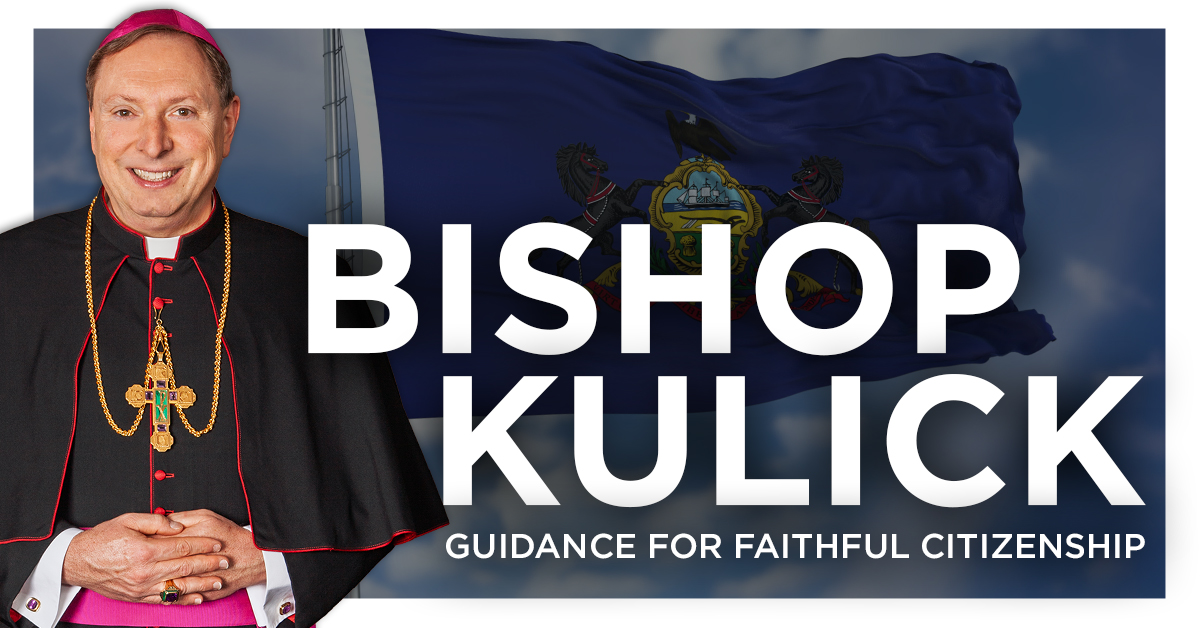
The Most Reverend Larry J. Kulick, JCL
Bishop of Greensburg